CPU AI Opponents
Real AI managers — they draft, trade, negotiate, and DM
Most fantasy apps have CPU teams that are not really CPU teams. They are roster shells — collections of players that exist mainly to fill out a league when you do not have enough humans. They do not draft strategically, they do not propose trades, they do not respond to messages, and they certainly do not negotiate. MFL Fantasy's CPU AI is built differently. CPU teams here are full AI managers with their own decision-making, their own behavior, and their own personalities at the trade table.
This page explains exactly how the CPU AI works so you know what you are up against when you play against them — whether that is one CPU in an otherwise human league or an entire league filled with AI opponents.
What CPU Teams Actually Do
A CPU team in MFL Fantasy autonomously handles:
Drafting
CPU teams draft their own rosters using best-player-available logic weighted by positional need. They will not draft three quarterbacks in the first six rounds. They will not reach for a kicker in round 8. They follow the same general drafting principles a competent human would.
Lineup Management
Every week before games kick off, CPU teams set their starting lineup. They start their highest-projection players, account for bye weeks, and avoid starting injured players. They will swap in a bench player who has a great matchup over a starter who has a tough one.
Waivers & Free Agency
After every weekly import, CPU teams scan the waiver wire for upgrades. They drop low-performing players to add high-performing free agents. They prioritize positional needs — a CPU team weak at RB will hunt RBs even if a slightly better WR is also available.
Trades
CPU teams proactively propose trades to fill positional gaps and offload depth they do not need. They also evaluate and respond to incoming trade offers — accepting fair deals, declining lopsided ones, and counter-offering when there is a reasonable middle ground.
Direct Messages
You can DM a CPU team about a trade. They respond. Their replies are AI-generated based on the actual roster context — they will tell you what they need, push back on offers they do not like, and signal interest when an offer is close to fair. It is not just canned text.
The CPU Trade Negotiation
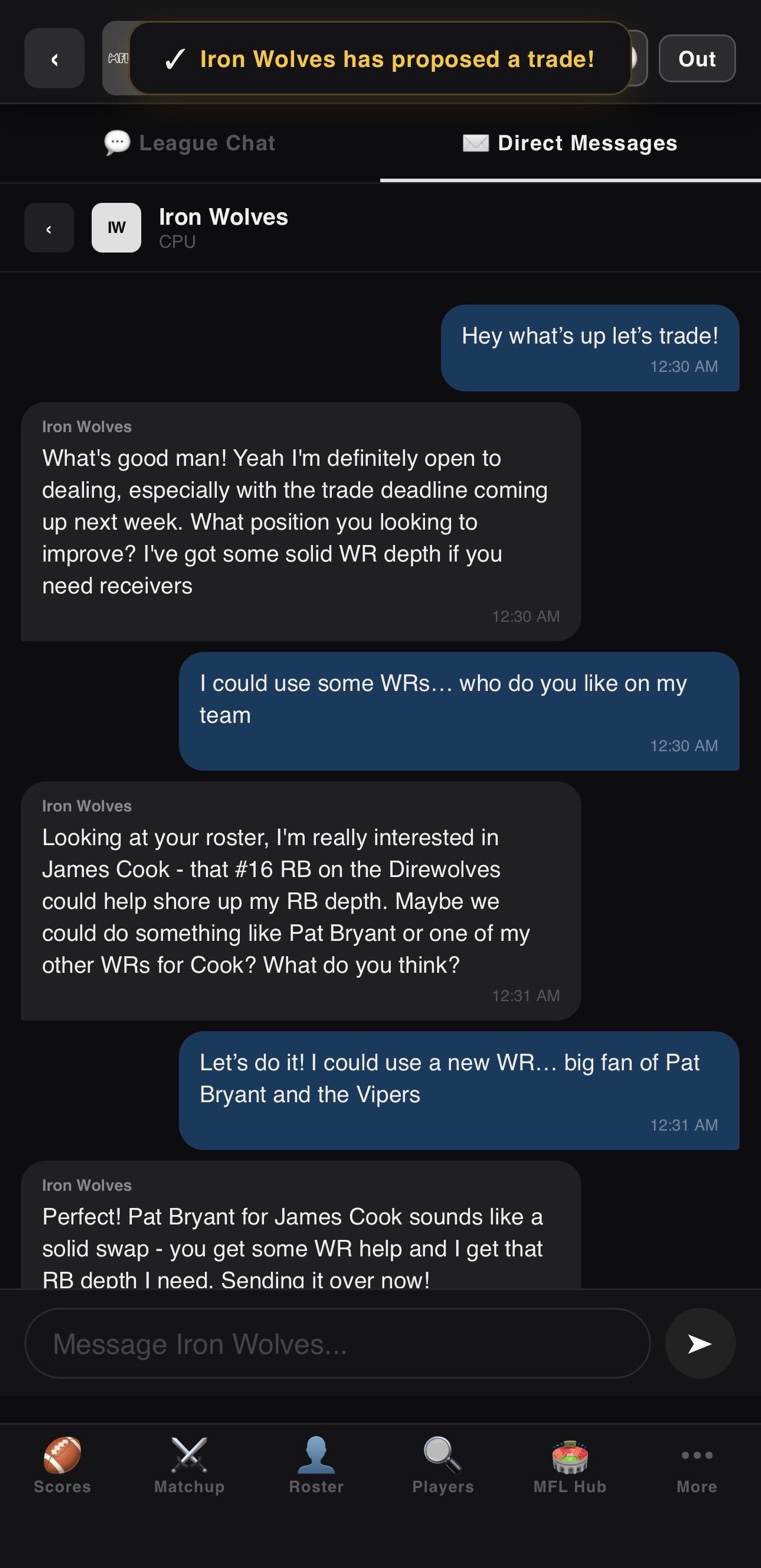
This is the feature most fantasy apps do not have. Open a DM with a CPU team and you can have an actual back-and-forth conversation. The AI evaluates your messages, considers the trade context, and responds with intent:
- Greeting messages get a friendly reply and an invitation to make an offer
- Specific trade proposals via DM get evaluated by the trade AI and a real response — yes, no, or "what about X instead?"
- Questions about their roster get answered based on what they actually have ("Yeah, I'm looking for WR help, I'm thin at the position")
- Pressure tactics ("come on, you owe me one") get pushback — CPUs do not capitulate to bad offers no matter how you frame them
The conversation feels closer to negotiating with a real manager than to interacting with a bot. Some users have gotten attached to specific CPU "personalities" they have negotiated with across multiple seasons.
How CPU Trade Decisions Get Made
When a trade offer hits a CPU team's inbox — whether from you or initiated by them — the AI runs an evaluation that considers:
- Total player value differential. What is the combined fantasy value of the players going each direction? If the gap is large, the trade is one-sided.
- Positional fit. Are they getting players at positions they actually need? An offer that gives them three RBs when they already have RB depth is less attractive than one that fills their TE hole.
- Player age and trajectory. Younger players with upside get bonus value. Aging players in decline get marked down.
- Current roster construction. A CPU team that just lost their starting QB to injury will weight QBs much more heavily for the next several weeks.
- Untouchable flags. Every CPU team flags 2-3 "untouchable" players — usually their elite producers — that will not move regardless of offer.
- Draft protection. Early in the season, CPUs hold their rookies and high draft picks tighter than they do mid-season, when value is more locked in.
The math nets out to a single decision: accept, decline, or counter. If the AI counters, it picks a counter-offer that brings the value differential into balance.
What CPU Teams Will Not Do
To set expectations:
- CPUs will not accept obvious dumps. Offering your three worst bench players for their elite WR will get declined every time. The AI sees the value gap clearly.
- CPUs will not take downgrades to "help you out." No sympathy trades. The AI is a fair-trade negotiator, not a charity.
- CPUs will not give up untouchable players. Each CPU has 2-3 protected stars they refuse to trade. You can probe to find them via DM ("would you consider trading Player X?") and the CPU will tell you straight up if X is on the table.
- CPUs do not chat for chat's sake. They respond to DMs that have trade-relevant content but they will not engage in pure trash talk loops. Save that for human opponents.
Playing in a CPU-Only League
You can run an entire league against CPU opponents. The full experience — draft, season, playoffs, championship — plays out exactly the way it would with humans, just faster. Some users prefer CPU-only leagues because:
- No-show managers do not exist. Every lineup gets set on time, every trade gets evaluated, every waiver claim happens. The league never gets stuck.
- You can run multiple leagues simultaneously. Some users keep 3-5 CPU leagues active at once with different strategies (one all-RB-heavy draft, one Zero-RB, etc.) to test approaches.
- The pace is whatever you want. No waiting for humans to log on. Once stats import, every CPU has already set lineups for the next week.
- Practice for human leagues. If you are new to fantasy football, a CPU-only league is a low-stakes way to learn the mechanics.
Mixing Humans and CPUs
The most common league format mixes humans with CPUs filling the gaps. If you have 6 friends but want a 10-team league, fill the 4 empty slots with CPUs. The league plays out exactly as it would with all humans — the CPUs are functionally equivalent to additional managers.
This is actually a feature most leagues use even when they have enough human players. CPUs ensure the league functions even if a human manager goes inactive or drops out mid-season. Some commissioners auto-convert no-show managers to CPU status after a couple of weeks of inactivity.
Strategy Tips for Playing Against CPUs
Probe Their Roster First
Before sending a formal trade offer, DM the CPU and ask about specific players. They will tell you who is untouchable and what positions they need help at. Use that info to construct an offer that actually has a chance.
Trade Depth for Stars
CPUs value positional balance highly. If you have 4 starting-quality RBs and they have an elite WR, an offer of 2-of-your-RBs for their WR often works. They get depth at a need; you upgrade your starting lineup.
Time Your Offers Around Their Injuries
When a CPU team's starter gets injured, their need at that position spikes immediately. The next 24-48 hours are the window where they will overpay for backup-quality replacements. Watch the news feed.
Do Not Bother With Lopsided Offers
The AI sees value gaps clearly. A "trick" offer that hides a bad deal behind multiple players will get declined immediately. Spend your effort on genuinely fair offers that just happen to align with your needs better than theirs.
Play Against the AI
Set up a CPU-only league in under a minute, or fill empty slots in a friends league with CPUs.
START PLAYING